Gregor's failed return to work
The MetamorphosisGregor's failed return to work is the opening crisis in which Gregor Samsa's private transformation becomes visible to both his family and his employer. He begins the morning still reasoning as a travelling salesman, calculating trains, contracts, lateness, and the debt owed by the family, but his altered body makes ordinary departure impossible. When the Chief Clerk arrives to investigate his absence, Gregor opens the bedroom door to explain himself and instead reveals a transformed figure whom no one can understand or accept. His attempt to preserve his job ends with the Chief Clerk fleeing and his father driving him back into Gregor Samsa's room, where the workplace's disciplinary pressure is replaced by domestic confinement.
Causes and Background
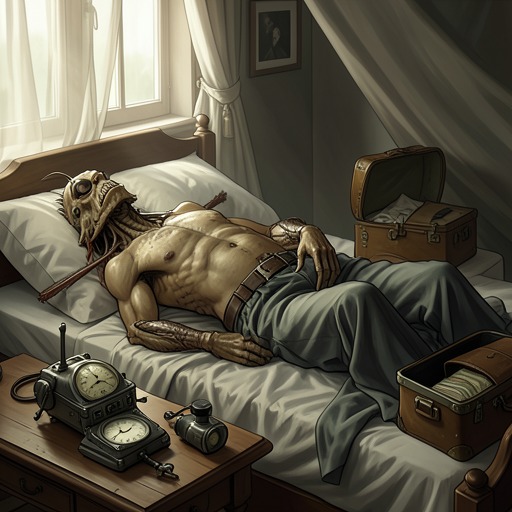
The immediate cause of the failed return is Gregor's overnight transformation into “a horrible vermin.” He wakes on his armour-like back, sees a brown, domed belly divided into stiff sections, and finds his many thin legs waving helplessly. Yet his first response is not to question the demands of employment but to treat the bodily change as an obstacle to his schedule. He looks toward the alarm clock, discovers that it is already nearly seven, and calculates that the five o'clock train has long since gone while the seven o'clock train would require frantic preparation and a hurried journey.
Gregor's anxiety is intensified by the structure of his work. He has served for fifteen years without taking a day off, and he expects any absence to appear suspicious rather than medically credible. He imagines that the Chief Clerk might arrive with a doctor from the medical insurance company, accuse his parents of having a lazy son, and accept the conclusion that no one is genuinely ill. Gregor even feels physically well apart from excessive sleepiness and an unusually strong hunger, so he interprets his changed voice as the beginning of a serious cold, an occupational hazard of travelling salesmen, rather than as evidence that his entire social identity has been ruptured.
The employment obligation is inseparable from family debt. Gregor intends to continue working until he has accumulated enough money to pay off his parents' debt to his employer, which he estimates will take another five or six years. Only then, he imagines, will he resign and make the major change he has postponed. His resentment toward the employer is therefore held in suspension by filial duty: he dislikes the early trains, the exhausting travel, and the superior who speaks down to subordinates, but he believes that his parents' security depends on his submission. The missed train thus threatens not merely a day's work but the arrangement through which the entire household has been sustained.
The Attempt to Leave
Gregor first tries to restore the normal sequence of the morning. He wants to rise without disturbance, dress, eat breakfast, and only afterward decide what to do. His cautious habit of locking every door at night, developed during his travels, now becomes an immediate barrier between himself and the family. His mother, father, and sister call through separate doors, but Gregor refuses to open his room because he still believes that he can get up, make himself presentable, and explain the delay.
The body defeats this plan at every stage. Gregor cannot use arms or hands to push himself upright; the small legs move in different directions and resist deliberate control. He attempts to swing his lower body out of bed, strikes the bedpost, and discovers that the lower part of his body is especially sensitive. He considers calling for help from his father and the maid, imagining that two strong people could lift him from the bed, but the thought of exposing himself while all the doors remain locked produces an absurd, helpless amusement. His movement is at once practical and humiliating: he must devise a new technique for a body whose capacities he does not yet understand.
By ten past seven, the arrival of someone from work makes delay impossible. A ring at the apartment door is followed by the maid's firm steps and the Chief Clerk's greeting. Gregor freezes, interpreting the visit through the logic of workplace surveillance. He wonders why a single absence requires the personal intervention of the employer's representative and thinks of the office assistant as someone who would already have reported his failure to board the five o'clock train. The alarm clock, the trains, the office report, and the visit to the apartment form a chain of observation that continues to govern Gregor even after his body can no longer comply with its timetable.
To get to the door, Gregor pushes himself along with a chair, braces himself against the wood using the adhesive tips of his legs, and turns the key with his mouth. He has no proper teeth, but his jaw is strong enough to rotate the key; brown fluid runs from his mouth over the lock and onto the floor, marking the effort with a bodily sign that the people outside cannot interpret as an act of determination. When the lock finally snaps open, Gregor feels encouraged and thinks that he has not needed the locksmith. The mechanical success, however, only prepares the social disaster: the door is opened before he can conceal what he has become.
The Confrontation with the Chief Clerk
Gregor's emergence changes a workplace investigation into a scene of mutual incomprehension. The Chief Clerk has demanded an immediate explanation for the locked room, the unexplained absence, and Gregor's failure to perform his duties. He speaks on behalf of both Gregor's parents and the employer, identifies Gregor's recent turnover as unsatisfactory, and suggests that money recently entrusted to Gregor may have prompted suspicion. The speech exposes the employer's presumption that a normally calm and sensible employee can become a suspect through a single unexplained deviation.
Gregor answers with an elaborate defense of his reliability. He promises to open the door immediately, attributes his condition to dizziness, insists that he is already recovering, and asks the Chief Clerk not to make his parents suffer. He also argues that travelling salesmen are judged through gossip and groundless complaints because they spend almost the whole year away from the office and return exhausted without knowing what has been said about them. His speech remains organized around professional reputation and family protection, but the altered voice makes it inaccessible. To Gregor, the words become clearer as he grows accustomed to the sound; to everyone else, they cease to function as intelligible human speech.
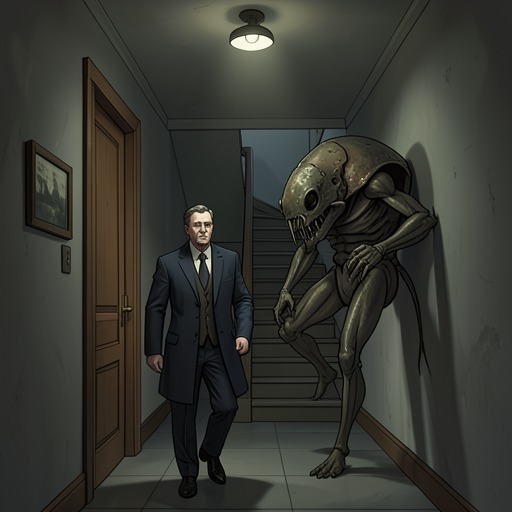
When Gregor finally turns through the double door, the Chief Clerk reacts with horror. He presses a hand against his open mouth, retreats gradually while keeping his eyes on Gregor, and then rushes toward the stairway as though an invisible force outside the apartment could save him. Gregor's mother collapses to the floor, while his father clenches his fists, covers his eyes, and weeps. The family members do not receive the patient worker they expected to see, and the representative of the firm does not receive a credible explanation. Gregor's attempt to speak for himself instead produces a spectacle in which his body overwhelms every verbal claim about his character.
Gregor nevertheless continues to interpret the encounter as a problem that can be repaired. He believes the Chief Clerk must be held back, calmed, convinced, and finally won over because the future of both Gregor and his family depends on the job. Even after the revelation, he cannot abandon the role of provider and employee. He moves toward the fleeing official, hoping to prevent the damage to his position from becoming final, but his unfamiliar legs first cause him to fall and then, once they touch the floor, unexpectedly carry him with greater steadiness. The brief pleasure of discovering that his legs obey him does not restore his former life; it only enables him to pursue the person who has come to judge him.
Forced Return and Immediate Consequences
Gregor's pursuit ends when the Chief Clerk reaches the stairs and his father takes control of the space. Instead of allowing Gregor to follow, his father seizes the Chief Clerk's stick, picks up a large newspaper, and uses both objects to drive Gregor toward the bedroom. Gregor's appeals are not understood, however humbly he turns his head. His mother opens a window and leans into the cold air, while the curtains and newspapers are stirred by the draught, making the apartment itself seem caught in the panic.
The return is not a guided re-entry but a violent expulsion. Gregor cannot move backward in a straight line, and his father stamps, hisses, and uses the stick to indicate the direction. The doorway is too narrow for Gregor's broad body, yet his father does not open the second door or allow him time to stand upright. Gregor's flank scrapes against the white door, leaving brown flecks and a painful injury; he becomes stuck, with some legs quivering in the air and others pressed against the floor. A final shove frees him and sends him, heavily bleeding, deep into the room. The door is slammed and bolted, converting the bedroom from a temporarily locked private space into the place to which Gregor is forcibly confined.
The physical consequences continue after the confrontation. Gregor sleeps in a deep, coma-like state until evening, then wakes with his left side stretched into one painful scar, a badly injured leg dragging lifelessly behind him, and greatly reduced mobility. His first movement after waking is toward food, but the sweetened milk that his sister leaves because it had formerly been his favorite no longer appeals to him. The failed return to work therefore initiates not only social exclusion but a progressive reorganization of bodily experience: Gregor can no longer travel, speak intelligibly, or eat according to the preferences associated with his former human life.
The family also begins to reorganize itself economically and spatially. Gregor's father later refuses to remove his uniform even at home, sleeping in it as if he remains ready to answer a superior's call. His mother sews for a fashion shop, and Grete Samsa takes a sales job while studying shorthand and French for a better position. The uniform, the sales work, the locked doors, and the employer's inspection show that Gregor's failed departure does not end the rule of labor; it redistributes that rule across the Samsa family. Gregor, once the worker whose earnings supported the household, becomes the body watched, fed, confined, and eventually treated as an obstacle to its renewed functioning.
Significance and Later Reversal
The event establishes the central contradiction of Gregor's transformation: his inner priorities remain attached to work, debt, and family obligation even as the institutions that defined him recognize only an unmanageable body. The Chief Clerk's visit supplies an external judgment before Gregor has time to understand himself. His room becomes an inspection point, the door becomes a boundary controlled by competing authorities, and the family apartment becomes the site where employment discipline is translated into physical force.
The episode also makes communication breakdown inseparable from power. Gregor speaks at length and believes that he is giving a coherent defense, but the family and the Chief Clerk hear only an unclear squeaking. Because his words cannot establish his identity, bodily appearance becomes the evidence used against him. The employer's suspicion, the family's fear, and the father's violence all proceed from the same failure: Gregor can no longer make his intentions count in the language by which human relationships had been maintained.
The wound caused by his father's later attack remains for more than a month as an apple lodged in Gregor's flesh. Its persistence forces the father to recognize, at least temporarily, that Gregor is still a family member rather than simply an enemy, but the recognition is limited and conditional. After Grete Samsa eventually declares that the creature must go and argues that the family can no longer treat it as Gregor, the bedroom door is hurriedly shut, bolted, and locked behind him. Gregor's body has thus moved from employee to suspect, from family member to confined animal, and finally toward an object whose disappearance permits the household to resume its life. The failed return to work is the first decisive step in that process: an attempted return to ordinary duty becomes the scene in which ordinary human status is withdrawn.